How to remove cooking odors naturally
Evangelize


May 28, 2026
Last night’s salmon should not still be haunting your curtains at breakfast. Yet here we are, standing in a kitchen that smells like garlic, grease, and regret, wondering how to remove cooking odors naturally without fogging the place with synthetic perfume. The good news is that most kitchen smells can be banished with a few ingredient-smart habits and a little strategy. The bad news is that one sad candle and a prayer usually won’t cut it.
Why cooking smells cling like tiny demons
Cooking odors are rude because they do not just float around in the air. Many of them attach themselves to grease particles, moisture, and fabric. That means the smell of fried food can settle into curtains, dish towels, upholstery, and even your hoodie hanging on the chair like it pays rent.
Some smells are easier to handle than others. Boiled vegetables, bacon, fish, curry, onions, and high-heat frying tend to be the worst repeat offenders. Smoke makes things nastier because it spreads fast and sticks hard. If your home has an open floor plan, soft furnishings, or weak ventilation, the odor has more places to hide.
That is why the real answer to how to remove cooking odors naturally is not one magic trick. It is a combination of stopping odors at the source, moving stale air out, and neutralizing what has already settled in.
Start with the air, not just the smell
If you want fewer lingering odors, ventilation is your first line of defense. Turn on the range hood before the pan gets hot, not after the smoke alarm starts auditioning for a lead role. If your hood vents outside, great. If it only recirculates, it still helps somewhat, but you may need extra support from open windows and fans.
Cross-ventilation works better than cracking one lonely window. Open two windows if possible and use a fan to push kitchen air out instead of just stirring the funk around. Even ten to fifteen minutes of active airflow after cooking can make a noticeable difference.
Humidity also matters. Steam traps odor, especially after simmering soups, frying, or boiling cabbage-like vegetables. Running an exhaust fan and wiping down damp surfaces helps prevent that muggy, stale smell from hanging around longer than it should.
How to remove cooking odors naturally at the source
The fastest way to beat a cooking smell is to keep it from spreading. That starts with cleaning while the mess is fresh. Wipe grease splatter off the stove, backsplash, counters, and nearby cabinet fronts as soon as the area is safe to touch. Once grease cools, it turns into a sticky odor scrapbook.
Take out food scraps right away, especially fish skin, onion peels, meat packaging, and anything sulfur-heavy. If the trash is the underworld portal, no amount of cinnamon on the stove will save you. Empty it, rinse the bin if needed, and sprinkle a little baking soda in the bottom before replacing the liner.
Don’t forget the sponge, dish rag, and sink drain. These are frequent odor accomplices. A sour sponge can make you think dinner still smells when really your cleaning tools are the problem. Swap or wash them often, and flush the drain with hot water followed by baking soda and vinegar if it is starting to smell questionable.
Natural remedies that actually help
There are plenty of old-school fixes for kitchen odors, but not all of them are equally useful. Some mask. Some absorb. A few genuinely help neutralize. The trick is using the right one for the right smell.
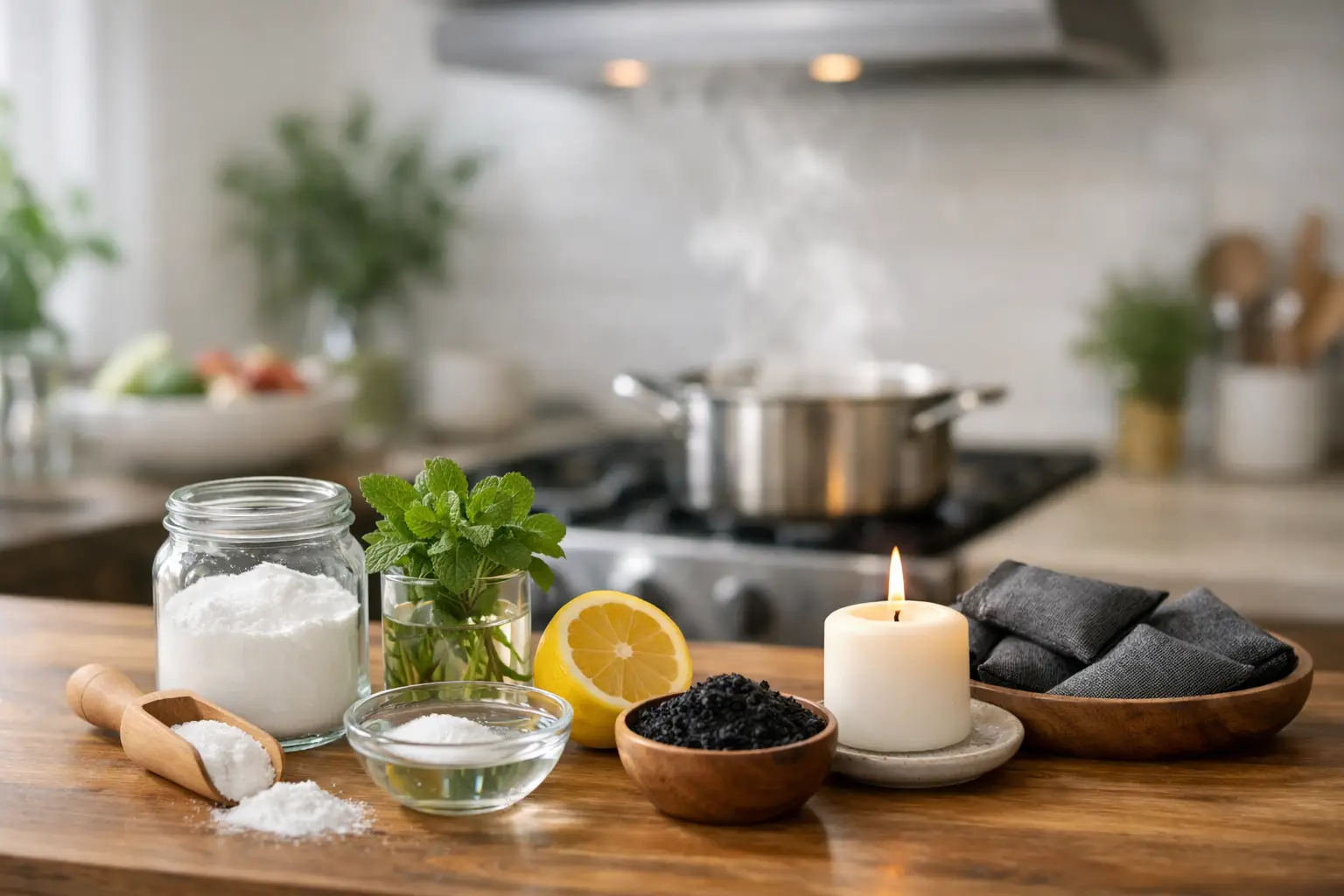
Baking soda is a classic because it absorbs odor over time. A small bowl near the stove or trash can help with background smells, though it is not an instant fix for a fish fry situation. Activated charcoal is stronger and better for persistent odor zones like pantries, under sinks, or near a garbage area.
White vinegar works well for sharp, lingering food smells because it helps neutralize airborne odor molecules. You can leave a bowl of it on the counter after cooking, or simmer a small pot of water with a splash of vinegar for a short time. Yes, vinegar has its own smell, but it fades fast and usually takes the worse crime with it.
Simmer pots can help, with one major caveat. If you simmer citrus peels, cinnamon sticks, cloves, or rosemary, your home will smell nicer, but that is mostly scent layering unless you have already cleaned the source. Think of it as the final blessing, not the exorcism itself.
Coffee grounds can absorb some odors in the fridge or trash area, but they are less practical for whole-room air. Lemon halves rubbed on a cutting board help after chopping garlic or onions. Salt can help scrub odorous residue from pans. These small moves matter more than people think because so many kitchen smells come from residue left behind, not the cooking event itself.
Soft surfaces are where cooking odors go to hide
If the kitchen still smells weird hours later, the odor may have migrated to fabrics. That is common in apartments, smaller homes, and open-concept spaces where the sofa sits one fried onion away from the stove.
Wash dish towels, table linens, and washable slipcovers regularly. If a fabric cannot go in the wash, air it out near an open window. Upholstery, rugs, and curtains may need a light, natural odor eliminating spray that neutralizes instead of burying the smell under fake fragrance. This is where a naturally derived formula can earn its holy status because soft surfaces are odor magnets.
Hard surfaces matter too. Wood, plastic, and painted cabinets can all hold onto cooking residue. A simple wipe-down with a gentle cleaner goes a long way. If the smell keeps returning, it usually means some greasy surface is still holding the memory of dinner hostage.
The worst offenders and what to do about them
Fish is brutal because it is oily and unmistakable. Ventilation, immediate trash removal, and pan cleanup are non-negotiable. After cooking, wipe surfaces and leave out vinegar or charcoal rather than relying on sweet scents to cover it.
Fried foods create a greasy haze that settles everywhere. Use a splatter screen, keep airflow moving, and clean nearby surfaces the same day. Waiting until tomorrow lets the odor set up camp.
Garlic, onions, and curry are not necessarily greasy, but they are potent and persistent. They cling to cutting boards, hands, and sink drains. Clean prep tools thoroughly and avoid leaving scraps indoors overnight.
Burnt food and smoke are their own category of chaos. If something scorches, turn off the heat, move the pan outside if safe, and ventilate aggressively. Then clean the oven, stovetop, or pan that caused the problem. Smoke odor rarely leaves on its own, because it is attached to particles that settle all over the room.
What not to do if you want a truly fresh home
The biggest mistake is trying to cover cooking smells with conventional air fresheners. That approach often creates a cursed hybrid odor – part bacon, part fake meadow, all bad decisions. If you are sensitive to synthetic fragrance, it is even worse. You get the smell plus the headache.
Another mistake is ignoring recurring problem spots. Trash cans, drains, oven interiors, microwave splatter, and greasy vent filters quietly keep the odor cycle alive. If your kitchen always smells a little off, there is probably a hidden source that needs cleaning more than it needs perfume.
Also, be realistic. Natural methods work well, but they are not identical in every situation. A quick veggie sauté is easy. A full seafood boil in a small apartment with no hood vent is harder. In tougher cases, you may need layered tactics: ventilation, cleanup, absorption, and a natural neutralizing spray for fabrics and surfaces.
A cleaner ritual beats a panic response
The easiest homes to keep fresh are not the ones with perfect kitchens. They are the ones with a routine. Run the fan early. Wipe surfaces after cooking. Empty odor-heavy trash fast. Wash the towel that absorbed half the smell. Treat fabrics before they start whispering yesterday’s dinner back at you.
If you want one product in the mix, make it one that tackles odor instead of staging a floral cover-up. That is the whole point behind cleaner, naturally derived options like Odor Exorcism – less fake fragrance theater, more actual smell removal.
A kitchen that smells like food while you cook is normal. A kitchen that smells like last Tuesday forever is a haunting. Handle the source, clean what the odor touched, and let fresh air do its sacred work.